In the world of the Vikings, beer was not merely a beverage for entertainment – it was a foundation of survival, a strictly enforced element of law, and it also had ties to magic. Beer was enjoyed by everyone, regardless of social status. Children and the elderly, warriors and servants, women... and even the gods drank it.
This article will take you on a beer-filled journey through the lands of the ancient North. You will learn how the Vikings brewed beer, from what vessels they drank it (we will debunk some myths along the way, and replicas from my own collection will serve as examples), you will discover beer stories recorded in the Eddas, read about beer runes, ceremonial rituals (as these were not just ordinary drinking bouts), but also about strict laws and what penalties awaited for failing to fulfill the obligation to brew beer (and the punishments were truly severe!).
So, beer in hand, and let’s begin!
What kind of beer did the Vikings drink?
Old Norse sources use two main terms for this beverage: öl and bjórr. Contrary to what one might think, these were not synonyms, but two completely different beverages.
Öl (ale) was a top-fermented beer, brewed mainly from barley malt. In the ancient North, it was not treated as a mere beverage —it was a fundamental yet safe (due to its low alcohol content and the absence of dangerous bacteria that might have been present in contaminated water) part of the daily diet, providing strength for hard work and helping people survive the harsh winters. This beveragewas a thick, nutritious “liquid bread,” packed with calories.
The brewing process and ingredients used to produce beer in those days differed significantly from modern techniques. Hops were not yet standard, as they are today. The Vikings brewed öl mainly from basic ingredients such as barley and water. Barley, a widely cultivated grain, was the primary source of the fermentable sugars necessary for the production of this beverage.
The entire process of brewing öl began with malting, that is, soaking the barley in water until it sprouted. It was then dried and ground. The next step was mashing, which involved pouring hot water over the grain to extract the sugars. This is how the so-called wort was produced.
The key stage—heating the wort—sheds light on the realities of that era. Large metal cauldrons were a rare luxury back then, so the Vikings used massive wooden vats. To bring the liquid to a boil, they threw red-hot, smooth brewing stones (bryggestein), which they pulled straight from the fire. This process sterilized the beverage, eliminating dangerous pathogens. It also caramelized the sugars, giving the beer a unique flavor.
The shelf life and distinctive character of the Viking beverage were ensured by wild herbs, mainly common marsh and yarrow. These had antiseptic and preservative properties.
After filtering the first, strongest batch of wort through juniper branches, the remaining grains were flooded with water again. This is how the so-called secondary beer (often also called “thin” or “light” beer) – a weak, cloudy brew with an alcohol content of about 1–2%. It was a beverage for everyday use, also served to children and servants to hydrate and nourish the body (without the risk of intoxication).
Fermentation began after cooling, when pieces of wood (known as kveikstokk), in whose crevices yeast cultures thrived.
The farmer personally blessed the finished beverage in the name of the old gods, and in later centuries—in the name of Christ and Mary.
In turn, bjórr was considered a stronger and more refined beverage. It is believed to have been much clearer and to have had a higher alcohol content than the common öl. Historians and linguists often associate this term with strong fermented beverages made from fruit or honey. It was not a drink for everyday meals. Bjórr appears in sources as a luxury beverage, produced in smaller quantities for special occasions for the elite (kings and jarls) and for the grandest feasts. It was this drink that was considered worthy of heroes.
The difference between these two types of beer was so significant that it even survived in mythology: in the song Alvíssmál (The Song of Alvis) we learn that while humans drink öl, for the gods (the Aesir) it is bjórr that is the worthy drink.
In stanza 34 of Alvíssmál, the god Thor asks the dwarf Alvis what the drink consumed by humans is called:
“Tell me, Alvis—for I know you know the fates of all creatures, dwarf:
What do they call the beer that the sons of men drink,
In each of the worlds?”
Alvis replies in stanza 35, pointing out the hierarchy and variety of names:
“Humans call it ‘Öl,’ the Aesir call it ‘Bjórr,’
the Vanir ‘Veig’ (the drink of power), the giants ‘Hreinalög’ (pure brew),
In Hel’s realm it is ‘Mjöd,’ and the sons of Suttung call it ‘Sumbl’ (the feast drink).”
It is worth noting that various translations often contain interpretations based on poetic license, which—though beautiful from a literary perspective—are sometimes far removed from the original meaning of these words (or completely incomprehensible). In my analysis, I opted for a direct translation, which, in my opinion, best captures the original meaning and character of these Old Norse terms.
What did the Vikings drink their beer from?
Pop culture has ingrained a single stereotypical image in our minds: a mighty warrior guzzling beer from a huge, ornate horn. Or even from the skull of a defeated enemy. And while drinking from a skull is utter nonsense (not supported by archaeological findings), drinking horns were indeed present, but the matter wasn’t quite so straightforward…
In the ancient North, the vessel from which one drank said a great deal about the nature of the occasion and even about the social status of the drinker himself. The Vikings mainly used three types of vessels: wooden bowls, cups, and ladles; horns; and imported glass. Pottery, thick and heavy, was rare during this period.
Simple bowls, mugs, and ladles—most often made of birch, alder, or linden—were used for drinking ordinary, everyday öl. They were often made by turning, though smaller mugs were also sometimes hollowed out by hand. Such vessels bwere cheap, light, and durable. Most of the population drank from them—from children to servants to free farmers. The more affluent reinforced them with metal hoops, which protected the wood from cracking and enhanced the vessel’s prestige. Wooden vessels could be attached to a belt—in this form, they accompanied every a traveler, hunter, or warrior.
Drinking horns (drykkjarhorn) did indeed exist, but they were festive and ceremonial vessels. They were used during formal feasts, such as Sumbl (which you’ll read about later in this article), or when raising ceremonial toasts. The horns had one key feature: due to their shape, they couldn’t be set down on the table. A filled horn therefore had to be either drunk to the dregs, or passed it along the circle—which perfectly united the feasting community. Ordinary people used horns from common domestic cattle. The elite—jarls and kings—imported enormous horns from aurochs or bison, which were inlaid with bronze or silver along the edges and tips.
Contrary to popular belief, authentic vessels from the Viking Age were rarely covered with intricate carvings across their entire surface. Most surviving examples indicate that the horns were smooth and carefully polished, with their main decoration consisting of elaborate metal fittings. If any pattern appeared on a horn, it was limited to simple, shallowly engraved geometric lines, a herringbone pattern, or a modest braided design, which emphasized the shape of the vessel itself. Runic inscriptions on horns were rare. They served no decorative purpose but were related to magic or served as a mark of ownership. Richly carved horns covered with dense plant motifs, bas-reliefs depicting people and animals or long inscriptions are in fact much younger artifacts. They date from the late Middle Ages and subsequent centuries, when the tradition of folk ornamentation flourished in Scandinavian villages.
If a chieftain wanted to demonstrate his absolute dominance, status, and wealth to his guests, what was brought to the table was… glass. In the North, it was a luxury and exotic commodity, imported mainly from the Frankish Kingdom and the Rhineland. Owning something so fragile and exorbitantly expensive in those days was more prestigious than any gold jewelry.
The glass imported to the North had a very distinctive appearance, which differed radically from today’s perfectly transparent glasses. The Vikings were unfamiliar with colorless glass —due to iron impurities in the sand used in the Rhineland glassworks, glass from that period was olive, light green, yellowish-green, or blue-green in color. The walls of the vessels were full of microscopic air bubbles embedded within them, as well as streaks and irregularities, because the glassworks of that time were unable to perfectly purify the molten glass. To make the vessels more durable and less slippery in hands greasy from festive feasting, glassmakers very often decorated them with an external braided pattern. Hot, hot, stretchy glass threads, creating raised patterns on the surface: spiral lines, grids, or vertical ribs. There were also goblets decorated with glass “drops” (protrusions), which ensured a secure grip while drinking.
Most of the imported glass that reached Scandinavia during the Viking Age consisted of so-called funnel-shaped goblets and conical goblets. These vessels—like horns—had neither a flat bottom nor a stem. They tapered toward the bottom, ending in a sharp point or a rounded bottom. This meant that the cup had to be held in the hand throughout the feast and could only be set down once it had been completely emptied.

Below you can see drinking vessels from my own collection: ra goblet—an example of a modern interpretation with decorative engraving and a hand-forged metal stand—and awooden ladle, faithfully capturing the everyday character of a simple and practical utensil for daily use.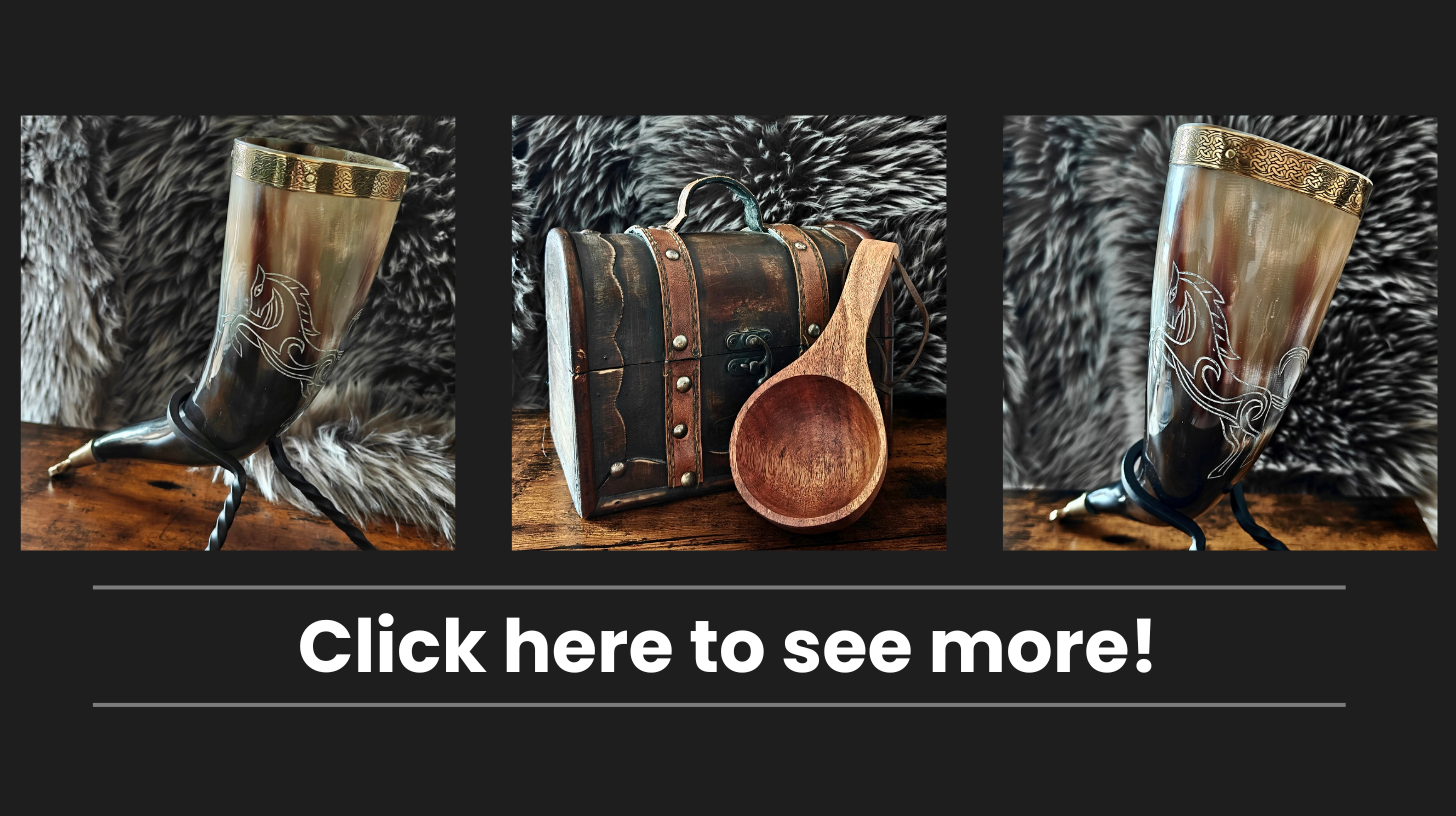
Beer in Norse mythology
In mythology, beer flowed in streams, and the gods regularly feasted at the giant Ægir, who brewed it in a gigantic cauldron. Odin himself Odin himself, in the poem Hávamáldevoted considerable attention to drinking alcohol, though he sternly warned against losing control. He advised drinking in a way that preserves clarity of mind, for only sober judgment allowed one to survive in the harsh world of the north.
“There is no better burden for the journey
Than great wisdom;
There is no worse provision for the journey
Than excessive beer-drinking.
It is not as good as they say it is,
Beer for the sons of men;
For the more you drink, the less control you have
Over your own mind.
For the ‘heron of forgetfulness’ watches over the revelers,
It is she who steals a man’s reason;
I was bound by the wings of this bird
At Gunnlöd’s hall.”
But the most interesting of the beer stories recorded in the Eddas, in my opinion, is the one that tells how the brewing cauldron even came into Ægir’s possession in the first place.
Once upon a time, the gods, thirsty for a feast, arrived at the great hall of the giant Ægir, situated on the seashore. Thor ordered him to prepare a feast for them. Ægir had no desire to feed the Aesir, but he had even less desire to fight them, so he came up with a ruse. He promised the gods the most magnificent feast they had ever sat down to, but he set one condition: they had to bring him a cauldron large enough for him to brew enough beer for all of them. He knew perfectly well that the Aesir did not possess such a large vessel…
The worried gods concluded that such a cauldron probably did not exist. However, Tyr, the god of war, saved the day. He informed Thor that his stepfather, the mighty giant Hymir, possessed a cauldron one mile deep—he had seen it with his own eyes. The two gods quickly boarded a chariot drawn by goats and set off for the jötun’s dark stronghold.
Upon arrival, the gods met Tyr’s mother, a beautiful giantess clad in gold, and his grandmother—a fearsome monster with nine hundred heads. The mother of the god of war feared for her guests’ lives, knowing that Hymir could be extremely inhospitable and quick-tempered. Therefore, as soon as she heard that the giant was returning from a hunt, she hid Thor and Tyr in a safe spot in the hall—behind a pillar, above which hung huge cauldrons.
Just as the giantess had predicted, Hymir flew into a rage. When his wife revealed to him the presence of their son and his companion, who had come to fetch a cauldron for brewing beer, the giant glared at the pillar with such fierce rage that it snapped. The eight cauldrons hanging from it crashed to the ground and shattered into a million pieces. Only one survived—the largest one.
Though furious, Hymir had to respect the sacred law of hospitality. He ordered three oxen to be slaughtered for supper. Thor, however, renowned for his monstrous appetite, ate two whole oxen by himself. Terrified by the lack of supplies (the food was supposed to last for several days), Hymir declared that they must go on a fishing expedition at dawn the next day.
When morning came, Hymir ordered Thor to find some bait for him. He sent him out to a field where oxen were grazing. What did the Thunderer do? He found the most majestic and fattest of the bulls (Hymir’s favorite), then struck it between the eyes, killing it on the spot. He then tore off its head, stuffed it into a sack, and carried it to a boat, which set sail into the ocean. Thor steered the boat toward the distant depths, even though the jötun had warned him that it was dangerous—the Midgard Serpent lived there.
Hymir’s hunt was successful. He caught two enormous whales, the largest Thor had ever seen. Then the god of thunder pulled his bait out of the sack. He impaled the ox’s head on the hook and cast it into the ocean. Jörmungandr then seized the bait. The hook pierced deep into his palate. Thor saw this as his chance to get rid of the giant serpent. He grabbed the rope and tried to haul the monster onto the deck. The serpent writhed in the water, spitting venom. Trying to free itself, it dragged the boat farther and farther into the watery abyss. But its strength was waning, and Thor gradually pulled it toward the boat. When the monster was close enough, Thor raised his hammer Mjölnir, to smash Jörmungandr’s head. Then, terrified by the vision of the end of the world, Hymir cut the rope. The serpent fled back into the depths.
They returned to shore in silence. Hymir, wanting to save his honor, issued a double challenge to Thor. First, he ordered him to carry the boat, along with the whales, right up to the hall’s threshold —which Thor did, carrying the entire hall on his back. Next, the giant challenged the god of thunder to a test of strength, ordering him to shatter his magical cup. Thor hurled the vessel at the stone pillars, but they crumbled to dust, and the cup remained intact. Then Tyr’s mother whispered a secret to Thor—he was to strike Hymir’s own skull, which was harder than anything in the world. The lord of thunder gathered all his strength and hurled the cup straight at the seated giant’s forehead. The jötun’s head survived, but the cup finally split in half.
Seeing the cracked cup, Hymir wept over the loss of his treasure and admitted defeat. Acknowledging the god’s superiority, he told the Aesir that they could take the great brewing cauldron if they could manage to carry it out of the hall. He was counting on the gods failing the challenge, however, as the cauldron was monstrously heavy. Tyr tried first, but couldn’t move it even a millimeter. Thor, on the other hand, grabbed the cauldron by its rims, hoisted it onto his head like a giant helmet (so that the hoops clanged around his heels), and strode toward the exit, leaving the giants gaping in astonishment.
The Aesir left the hall and set off on their return journey. Their triumph, however, did not last long. When Thor looked back, he saw an army of Jötuns approaching, led by Hymir. The giants wanted to reclaim their cauldron. Unfortunately, one of Thor’s goats was limping andcollapsed under the immense weight of the cauldron (his leg had once been broken, thanks to Loki, but that’s another story), so a confrontation with the giants was inevitable. Thor raised his hammer. He slew the jötuns one by one until, finally, the ground ran red with blood.
The victors delivered the cauldron to Ægir’s halls. The sea giant received the vessel he had demanded and kept his word. From that time on, during every autumn solstice, a great feast was held at Ægir’s, where there was never a shortage of beer brewed in Hymir’s cauldron for the gods.
I also recommend the version of this story written by Neil Gaiman in his *Norse Mythology*. It contains many humorous elements that you won’t find in the Eddas. For example, Tyra’s grandmother chops onions as big as boulders and cabbages the size of boats, each head uglier than the last, and Hymir returns to shore carried by Thor along with his boat and the whales he’s hunted 😉
Beer Runes (ölrúnar)
But beer wasn’t just a nourishing drink or a source of pleasure for the gods. It also had a magical dimension. In Norse mythology and the sagas, there are references to beer runes (Old Norse ölrúnar). Their purpose was to protect against poisoning and betrayal, and to ensure that no one would violate the rule of hospitality toward the drinker. For the magic to work, the symbols had to be carved onto a drinking horn or a cup, as well as onto the body—specifically on the back of the hand and on the thumbnail.
However, a great deal of linguistic confusion has arisen around this ritual, because in the literature, the same rune appears under two different names: Naudiz and Naudr. Where did this come from? It stems from the fact that Norse myths traveled a very long way before anyone wrote them down on paper. Stories about the gods and the mead runes originated hundreds of years before the Viking Age (during the Migration Period). The Germanic peoples of that time used an alphabet consisting of 24 characters, known as the Elder Futhark. In this original system, the rune responsible for protecting the drink was called Naudiz (ᚾ). When the Viking Age began (8th–11th centuries), the old alphabet was simplified and reduced to just 16 characters—giving rise to the so-called Younger Futhark. The Vikings, who sang songs about beer runes and carved them onto their drinking cups, were already using this newer version. In their language, the same rune was renamed Naudr. All these stories were finally written down only in the 13th century by Christian scribes in Iceland. In their texts, they preserved knowledge of ancient rituals but used names more familiar to the Viking era.
Regardless of whether we refer to the aforementioned rune by its ancient name Naudiz, or by the term closer to the Vikings, Naudr, the meaning of this symbol remained unchanged: it signified “need,” “compulsion,” or “affliction.” The choice of this particular rune was meant to compel reality to reveal the truth. It was intended to thwart the evil intentions of the person serving the drink.
The most detailed instructions regarding this ritual are found in the Poetic Edda, specifically in the poem Sigrdrífumál (The Song of Sigrdrífa). In stanzas 7 and 8, Valkyrie Sigrdrífa gives the hero Sigurd direct advice on how to use the mead runes to protect himself from deceit and betrayal:
“Learn the beer runes, so that a foreign woman
May not betray your trust when you trust her;
Carve them on the corner and on the back of your hand,
And the sign of Naudr on your fingernail.
The cup must be enchanted to protect against danger,
And a piece of por* must be thrown into the brew;
Then I know for certain that never for you
Will honey be laced with treachery.”
*In the original text Sigrdrífumál the Valkyrie uses the word laukaz. In Old Norse, this word means wild garlic or leek—a plant considered magical.
The best evidence of how the Vikings understood the practical effects of mead runes can be found in The Saga of Egil (Old Norse Egils saga Skallagrímssonar)in Chapter 44. The brilliant skald and ruthless warrior Egil Skallagrímsson was attending a feast hosted by Bárðr, one of King Erik Bloodaxe’s men. Bárðr, acting on the orders of Queen Gunnhild, who sincerely hated Egil, decided to poison him. A deadly poison was added to the horn of beer intended for Egil, but the hero immediately sensed the trick. Instead of drinking, he drew his knife, cut his hand, and used his blood to inscribe on the cup protective runes, while uttering a magic spell in which he called upon the host’s intentions to be revealed. At that very moment, the horn burst, and the poisoned drink spilled onto the ground.
When discussing beer runes, it is worth mentioning the word ALU, written in the runic alphabet as ᚨᛚᚢ, which is sometimes associated with them in popular science literature, although its exact meaning remains a mystery to researchers. This notation consists of three specific runes of the Elder Futhark, each of which had its own assigned name and basic conceptual meaning in this writing system:
- ᚨ (A) – Ansuz: means “god” or “one of the Aesir” (in Norse mythology, the main line of gods, led by Odin),
- ᛚ (L) – Laguz: means “water,” “lake,” or generally “liquid” (in popular online articles, the middle rune is sometimes mistakenly called the “season rune” (Laukaz), which is an attempt to force a connection between this notation and the instructions from Eddy Poetycka),
- ᚢ (U) – Uruz: means “aurochs” (a wild mammal now extinct), which in Germanic symbolism represented strength, health, and vitality.
There are two main schools of thought regarding the interpretation of this ancient inscription. Some linguists link the word alu etymologically with the Proto-Germanic aluþ, that is, with beer. According to this theory, the word for the beverage eventually acquired the status of a protective formula. Other researchers, however, reject this theory, deriving alu from Indo-European roots meaning “protection” or “taboo” —in this context, it was simply a universal incantation meant to ward off evil.
ALU inscriptions have been found on various artifacts from the first centuries CE: from medallions to everyday objects to urns, making it impossible to prove an unambiguous link between it and beer-drinking culture alone.
The sumbl ritual
A key moment in the life of the Norse community was the sumbl
(or, from Old English, symbel). Unlike a simple feast involving food and celebration (referred to as veizla or gildi), it was a formalized, even sacred feast, at which the fates of individuals and entire communities were decided. The sumbl was a ritual focused exclusively on drinking, speeches, and the magic of words. It usually took place indoors, most often in the chieftain’s main hall (mjöðhall).
Sumbl followed a strict script, overseen by the host (the king or chieftain) and a woman of high birth (often the chieftain’s wife), who served the drink. The host occupied the “high seat” (öndvegi) and, by raising the first horn or cup of beer (or mead), began the ritual. The order of drinking was not a matter of chance—it was determined by the social status of the revelers. The lady of the house serving the drink was therefore not a mere waitress, and her rounds among the benches carried immense political weight. By handing the horn to a specific warrior at right moment, she publicly demonstrated his place in the squad’s hierarchy. As the guardian of the banquet’s order and the rules of hospitality, she was also tasked with tempering the tempers of proud men. Omitting someone from the horn was considered a grave insult, which often resulted in bloody revenge. Before raising the horn to their lips, each participant had to deliver a speech, propose a toast, or make a declaration.
According to the tradition described by Snorri Sturluson, three key toasts were raised during the Sumbl. PThe first round was dedicated to the gods —Odin, Njörd, or Frey—as a plea for victory, peace, and a bountiful harvest; and after Christianization, to Christ, Mary, and the saints. The second round was dedicated to the ancestors and fallen heroes (minnisfull), whose memory was thus honored. The third round, in turn, had a direct impact on the fate of the living warriors. It was then that solemn oaths were taken (heitstrenging), during which a warrior publicly committed himself to performing a specific, extremely difficult combat feat.
The culminating moment of this stage was the raising of the so-called bragarfull – “cup of promises” or “the chieftain’s cup”. It was a horn filled to the brim, of immense social and legal significance. The warrior taking the oath had to rise from his seat, raise the cup high into the air, consecrating it with the gesture of Thor’s hammer, recite the oath, and then drink the contents to the very last drop.
It was during this phase of the sumbl, when the alcohol was heating up the atmosphere, that the traditional comparison of men (manna-jöfnuðr). This was the moment when proud warriors outdid one another in tales of their exploits, arguing publicly over which of them was braver, had accomplished greater deeds, or enjoyed the chieftain’s greater favor. Combined with strong mead or beer, these verbal skirmishes regularly became the spark for bloody, deadly feasting conflicts.
In the royal sagas bragarfull appears as a key element of succession and the legitimization of power, for example during funeral feasts (erfi). A new chieftain or pretender to the throne gained full, tradition-sanctioned right to take the place of the deceased ruler only after accepting this ceremonial cup and solemnly pledging before his retinue to continue his predecessor’s great deeds or to avenge his death.
Words spoken under the influence of alcohol during a sumbl were not treated as drunken boasts—it was believed that they were permanently woven into the web of cosmic fate (Wyrd), becoming part of the inviolable, primordial law and destiny known as ørlög. Breaking an oath sworn over bragarfull meant defying these cosmic forces and a complete loss of honor. A man who committed such a betrayal earned the name outcast and coward (níðingr). This stigma entailed complete ostracism and civil death; níðingr was excluded from the community and placed outside the law, which meant that anyone could kill him with impunity.
A penalty for not having beer for the holidays?
In the countries of the ancient North, brewing beer was not merely a pastime or a privilege, but also a legal and religious obligation of every free farmer. The regulations governing this were in effect in various regions of Scandinavia —from Swedish provincial law (Östgötalagen) to other parts of Norway. The most stringent and best-documented record has survived in the Norwegian Gulathing Code (Gulaþingslög), whose oldest regulations date back to the 10th century.
According to surviving records, spouses were legally required to prepare alcohol for the most important holidays of the year (including Yule, and after the adoption of Christianity—for Christmas Eve). The original recipe stated: “The beer must be brewed from a measure of malt contributed in equal parts by the husband and wife”. Many myths have arisen around this sentence, claiming that the Vikings weighed married couples and ordered them to brew as much beer as they themselves weighed. In reality, the point was that the malt was to come from the couple’s joint property, contributed in equal shares, and the spouses were equally responsible under the law for fulfilling this obligation.
The regulations imposed a strict obligation on the farm to use at least three mælar of malt (approximately 48 liters of raw grain), which yielded between 100 and 130 liters of strong holiday beer. Poorer farmers had to pool their resources—three of them contributing to one sáld (about 100 liters of malt) and brew the drink together—no one could use a lack of resources as an excuse. The finished beverage had to be publicly blessed in the name of the gods, and in later times, “in thanks to Christ and the Virgin Mary for a good year and peace.”
Failure to comply with the order to brew beer was treated as a serious offense against public order. The penalty system showed no mercy. For failing to fulfill the obligation to brew beer on time, the farmer had to pay a fine of three silver marks to the bishop. If a farmer failed to brew beer for three winters in a row or refused to pay the fines, he lost the right to everything he owned. His property was confiscated and divided equally between the king and the bishop, and the offender himself was banished from the country.
Why was the law so ruthless? In the Norse world, refusal to participate in communal beer brewing and feasting meant that the host did not want to “intertwine his fate” with the rest of the clan. In a society where a shared destiny (ørlög
Modern scholars suggest that politics and faith were also at play. Kings such as Hakon the Good wanted to “baptize” pagan customs. Instead of banning toasts to the old gods, they legally mandated that toasts be raised to Christ and Mary, seamlessly integrating the old tradition into the framework of the new order.
Today, no one will bring you before an ecclesiastical court for not having homemade beer for the holidays, and runes on the hands are more often seen as tattoos than as a magical tool for survival carved into fingernails. And although we feast under different circumstances, I think this ancient, Norse cult of community still has something worth cherishing.
If you were to sit down to sumbl today in an ancient hall, I’m curious: what single promise—no matter what — would you be able to make publicly before your team? I look forward to your answers. Skål!
Text by: Iwona Strychalska
For years, I’ve been immersed in the world of Norse legends, Vikings, and the ancient beliefs of the North—the very same ones I’ve recently been able to share with you as part of the Forge of Baldur. My everyday life, from my home decor, to my appearance and tattoos, all the way to memories of my trips to Iceland, is inextricably linked to this heritage, which I try to convey in every one of my Instagram posts.
I’m currently working on a book Nine Realms of Sorrow – a collection of my poems and hand-drawn illustrations, steeped in mythology, folklore, and the spirit of ancient warriors. I’ll take you on a journey through nine mythical realms, where betrayal, death, and melancholy intertwine with echoes of ancient times. And so that you don’t get lost in these ruins, I’ve prepared a glossary —a key that will allow you to unravel the secrets of skaldic songs, Old Norse concepts, and forgotten rituals. If you’d like to join me on this journey and discover the North together, follow my profile!






Comments (0)