The death of Baldur was not merely the end of an era of light in Asgard; it became the kindling for a merciless vendetta. In a world governed by the rigid laws of the blood feud, intent gave way to the act itself, and every debt had to be paid in blood. While the Aesir were drowning in grief, the machinery of vengeance began to turn, set to reach both those responsible for the tragedy: the blind god who loosed the arrow, and the traitor who guided his hand. However, the verdict on Baldur’s slayers had been passed before the god of light even drew his last breath. This is a story of cruel destiny, secrets, and how Asgard meted out its justice.
This text was written by Iwona Strychalska. If this text has helped you deepen your knowledge or inspired you to create, follow Iwona’s profile by clicking here!
The Prophecy of the Völva
Odin carried a terrible secret within him. For some time now, he had known everything… He knew that Baldur would perish and that Höd would be the one to slay him. Yet, he could do nothing. He could tell no one. He had to watch as his sightless son unknowingly became the executioner of his own brother. As the God of Wisdom, he understood that destiny cannot be cheated, and to intervene would mean breaking the sacred laws of the cosmos.
It all began when Baldur was first besieged by grim dreams. Odin did not tarry. He saddled Sleipnir and galloped toward the realm of the dead. He had to know, at any cost, if his son’s visions were truly prophetic.
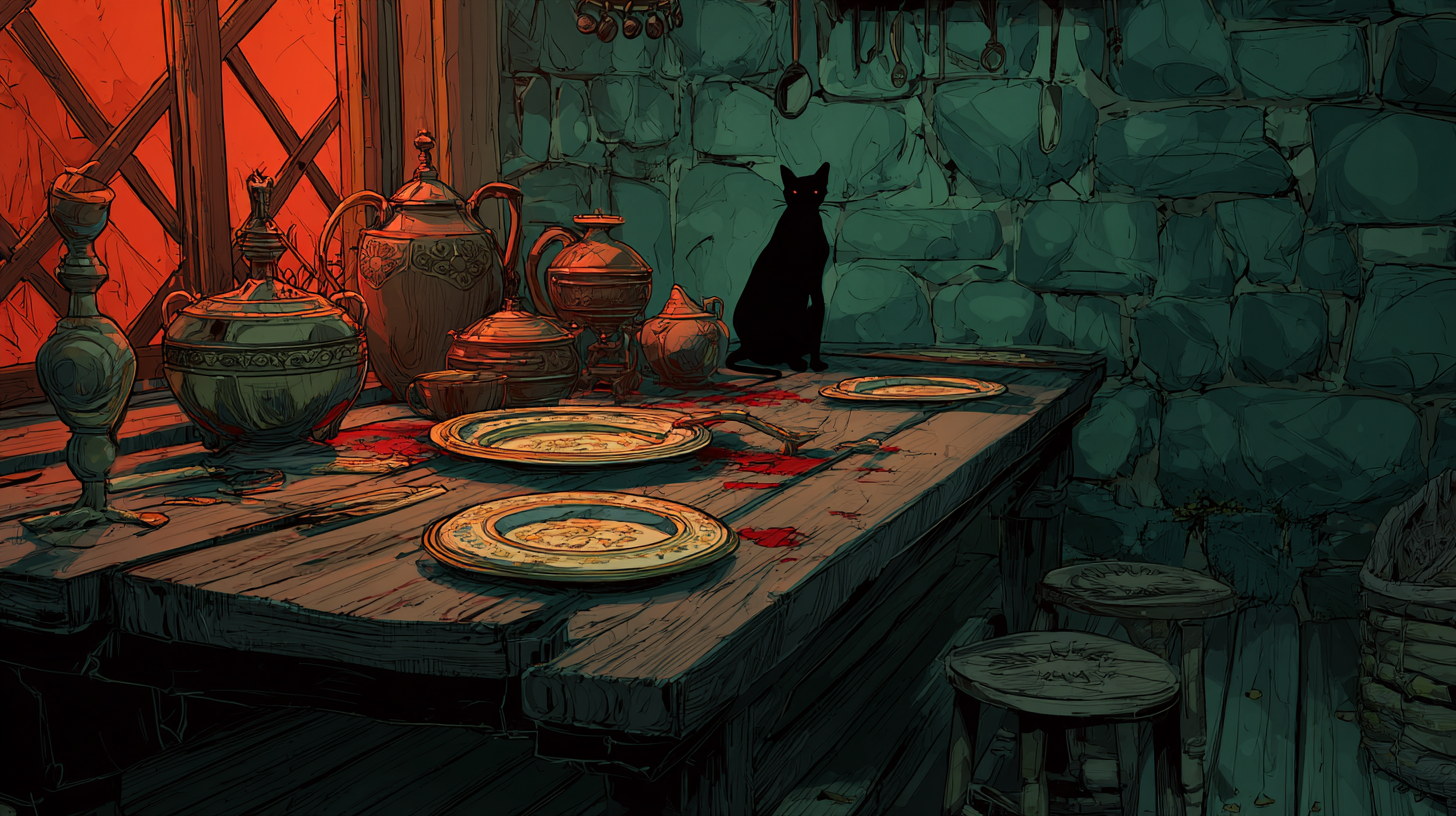
At the gates of Helheim, the All-Father was met by the guardian Garmr—a blood-stained, mighty hound that howled ominously at the sight of the god. Odin passed him without hesitation. When he reached the high thresholds of the goddess Hel’s palace, a strange sight met his eyes. Instead of the usual lethargy that shrouded the kingdom of the dead, he found feverish preparations for a great feast. Benches were strewn with gold, beds were finely made with costly fabrics, floors were swept clean, and a shield and cup waited upon the table. To Odin, the signal was clear: Hel expected someone of immense importance. Someone to be received with royal honors. Yet, the gilded benches offered no answer to the question that chilled the All-Father’s blood—were Baldur’s dreams an inescapable sentence of fate?
Odin knew that Hel would not surrender her secrets willingly, so he pressed on. He sought a truth that lay beyond the reach of the lies and courtesies of the palace dwellers. His destination was the wind-swept burial mound on the eastern edge of Helheim, where a powerful Völva (seeress) had rested for centuries.
The All-Father stood over her grave and began to chant galdr—potent and perilous incantations of resurrection. With magic, he forced the spirit of the deceased back into her decaying form. The Völva, enraged and pained by her sudden awakening, spoke from the grave:
– What man is this, to me unknown, who has laid this weary path for me? I was snowed over, beaten by rain, and drenched with dew; long have I been dead.
Odin did not reveal himself as the King of the Gods. He used the name Vegtamr (“Way-tamer” or “Accustomed to the road”) and began to ask questions, feigning mere curiosity. He asked about the preparations in Hel’s realm:
– For whom are these benches strewn with gold, and the chambers so finely swept?
– Here stands the mead brewed for Baldur, the bright drink, covered by a shield; the sons of the gods are in great despair. Compelled I have spoken, now I wish to be silent.
But Odin would not relent. Bound by the magic of his words, the Völva was forced to answer. She revealed the weave of destiny that even the gods could not alter. It was then that the crucial names were spoken: Höd as the one who would strike the fatal blow, and Vali, son of Rindr, who would avenge his brother before he had even washed his hands.
At the very end, Odin asked the question that betrayed him. He asked of the “maidens who shall weep and cast the ends of their veils toward the sky.” This was his undoing. No mortal journeys to Helheim to pose riddles regarding the ultimate fate of the world. The seeress suddenly realized that beneath the wanderer’s hood hid the All-Father himself. She cried out:

– You are not Vegtamr, as I believed! You are Odin, the ancient sorcerer!
Odin, seeing he was recognized, ceased his pretense and answered her just as sharply:
– You are no seeress, nor a wise woman; rather, the mother of three giants are you!”
The Völva, feeling Odin’s magic wane, commanded him to depart. She declared that no one would wake her again until the bonds are broken and Ragnarök arrives. Odin returned to Asgard with the harrowing certainty that his son’s death was inevitable, and that he had just heard the death sentence pronounced upon the entire world.
The Hunt for the Culprit
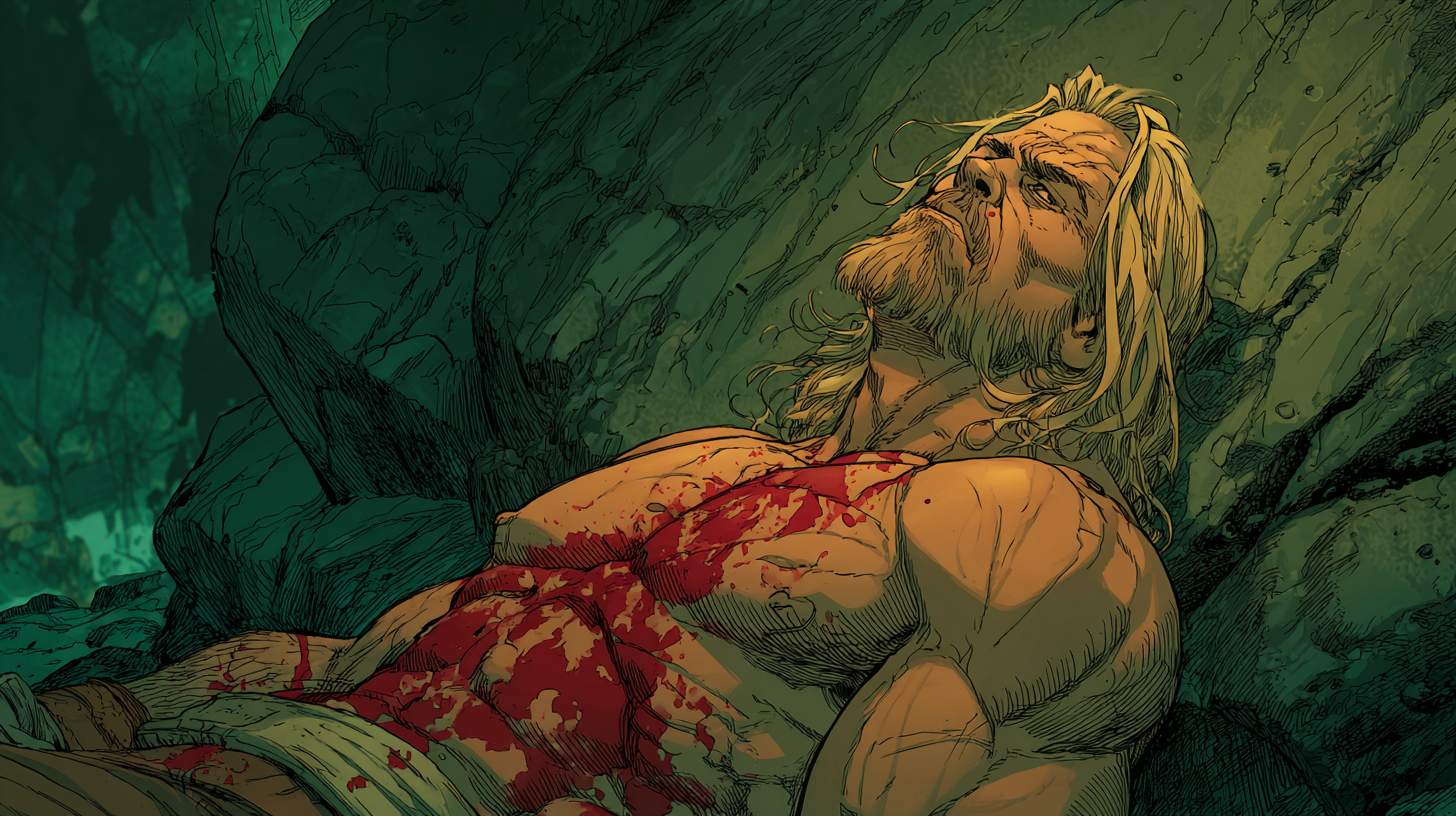
When the mistletoe pierced Baldur’s breast and the God of Light slumped lifeless to the ground, a silence fell over Asgard unlike any the world had ever known. The sagas describe this moment as one where all the gods were struck dumb, and their hands hung in a leaden paralysis. They stood motionless, unable to comprehend how the impossible had come to pass. In the midst of this dead silence stood Höd. He was disoriented, unable to see the bloody consequences of his deed, while Loki struggled to conceal his satisfaction beneath a mask of forced bewilderment.
When the first wave of despair subsided, the eyes of all fell upon Höd. Though it was his hand that loosed the fatal missile, the gods immediately realized that this crime had not originated in his mind. They saw his genuine terror and lack of hatred. They knew the blind man had been cruelly led by someone else.
Loki betrayed himself. In the moment when the other gods tore their hair and drowned in grief, he maintained a cold distance. He was the only one who did not shed a single tear. The Aesir quickly connected the facts. It came to light that Loki had stood behind Höd’s shoulder, it was he who placed the mistletoe in his hands and he who pointed the direction of the throw, and the blind god was merely a tool in his hands… Then the despair of the gods turned into fury.

The Harsh Law of the Gods
Unfortunately, in the world of the Aesir, intention did not matter, only the act itself. Even if Höd was an unconscious tool, Baldur’s blood was on his hands. Kinship law demanded vengeance. The honor of Asgard had been violated, and only death could restore the shattered balance.
Odin had carried the knowledge of these tragic events ever since his journey to the realm of the dead. He knew that none of the present gods would raise a hand against Höd. The prophecy he had heard over the Völva’s mound was clear: the avenger must be someone from outside the current family circle. Someone born free from the bonds of brotherly love, yet carrying the blood of the Allfather in his veins.
Acting in accordance with this stern destiny, Odin seduced a giantess named Rindr. From this union, Vali was born – a god brought into existence solely to become an executioner. Vali was no typical child. He grew to full strength within a single day. As an avenger, he was bound by a sacred destiny: he washed not his hands, nor combed his hair, and he would not care for his appearance. He was to remain in a “raw” and impure state until Baldur’s blood was avenged.
Vali, being only one day old, went to where Höd was. Without unnecessary words, he carried out the sentence. The blind god died by an arrow (or, according to other sources, by the sword) of his younger brother, becoming the second, almost equally tragic victim of Loki’s intrigue. Only when Höd fell dead could Vali perform his first ablution – he washed his hands and combed his hair, symbolizing the end of his mission and his return to the world of civilized gods. He then became a full member of Asgard.
Thor’s Grip, or the Mystery of the Salmon’s Tail
Loki, sensing the oncoming wrath of the Aesir, fled far from Asgard into the high, inaccessible mountains. There, he built a house for himself that was to be the perfect fortress—it had four doors, each facing one of the four cardinal directions. The God of Mischief sat in the center of the room all day, nervously glancing in every direction to spot any approaching danger in time.
Anticipating that the gods would search for him in the water, Loki began to ponder how they might catch him there. He took a linen cord and wove it into meshes, creating the first fishing net in history. It was then, through one of the doors, that he saw the Aesir approaching—Odin had finally tracked him from his throne, Hlidskjalf, from which all worlds are visible. In a panic, Loki threw the net into the fire to destroy the evidence of his craft, transformed himself into a salmon, and leaped into the nearby waterfall, Fránangr.
When the gods entered the empty house, they smelled something burning. Kvasir, the wisest of all living beings (born from the mingled saliva of all the gods as a sign of peace, thus possessing the wisdom of the entire pantheon of the Aesir and Vanir), leaned over the embers. He noticed a geometric pattern there—the ash had preserved the shape of the meshes Loki had burned seconds before his flight. Kvasir immediately connected the facts: the God of Mischief had created a tool for pulling life out of the water, and since he had invented it, he must be hiding beneath the waves in the form of a fish.
The gods immediately wove their own net, modeled after the pattern left in the ash. It was a twist of irony: the Aesir used Loki’s own invention to capture him. With the net ready, they headed to the river below the waterfall. They divided into two groups and stretched the ropes across the entire width of the current, then began to wade upstream toward the waterfall, “combing” the riverbed with the net.
Loki, in his salmon form, saw the approaching danger. He lay flat on the bottom between two stones, allowing the net to pass over him without even a touch. Having caught nothing, the gods realized their quarry must be hiding right against the ground. To the lower edge of the net, they tied heavy stones so it would scour the very sand and force the fish to surface. Thor stepped into the middle of the river, wading through the icy current, while the other Aesir pulled the net toward him.
Loki was trapped: behind him roared the Fránangr waterfall, before him the net was tightening. He knew that this time it would crush him. He had two choices: either be caught or leap over the top edge of the ropes and escape with the current to the ocean. He decided to risk everything. The Loki-salmon surged powerfully out of the water with a great splash, confirming to the gods exactly where their target was.
It was then that Thor displayed his superhuman reflexes. He lunged and caught the fish in mid-air. Loki was so slippery that he nearly slithered through the Thunder God’s fingers, but Thor squeezed him with all his might right by the tail. It is said that this is why, to this day, salmon have such a narrow and slender tail—it is a lasting mark of Thor’s powerful grip.

The Price of Betrayal
The gods’ revenge on Loki was as cruel and dark as the crime he had committed. The Aesir dragged the traitor to a dark cave, where they also brought Loki’s sons – Narvi and Vali. To inflict ultimate pain upon their father, they transformed Vali into a ravenous wolf. In this unnatural, magical form, Vali lost all control and lunged at his brother. He tore him to pieces before his father’s eyes, then vanished into the darkness, condemned to wander the woods as an eternal shadow on the conscience of Asgard.
But this did not yet exhaust the measure of the macabre. The gods used Narvi’s entrails to bind Loki to three sharp stones. These bonds immediately turned into iron, making escape impossible. Then Skadi, the goddess of the hunt, stepped forward, nursing a deep hatred for the trickster in her heart. She remembered well that he had led to her father’s death and humiliated her before the Aesir. Now the time for final payment had come. Above the bound god’s face, she hung a venomous serpent. From the creature’s mouth, burning poison dripped incessantly onto the eyes and bare skin of the prisoner. Each drop of venom was like liquid fire, reminding Loki of every betrayal he had committed in Asgard.
The only being who did not abandon Loki in this torment was his wife, Sigyn. She stayed by him unceasingly, holding a basin to catch every drop of venom to spare her husband pain. However, from time to time the vessel would overflow, and Sigyn had to leave to empty it. In those brief moments, the poison flowed straight onto Loki’s face. Then he would writhe in such terrible pain that the entire earth shook under his weight.
Loki remained in that cave for ages, sinking deeper into a growing hatred of the gods and planning his revenge. According to the prophecy, his bonds will break only on the day of Ragnarök. Then he will lead the army of the dead from Helheim and the legions of giants into the final battle against the gods. He will die there in a duel with Heimdall – the guardian of Asgard – striking him a fatal blow at the same time.
In my two articles, you have learned the tragic fates of the figures in this story, from the death of Baldur and his wife Nanna, through the attempt to rescue them from the realm of the dead, to the cruel punishment endured by those whose hands were stained with blood. I am curious, which character do you find most tragic? The beautiful and innocent Baldur, slain by his brother’s hand? Nanna, whose heart broke with grief? The blind Höd, who suffered death for a crime he would never have consciously committed? Odin, who harbored a terrible secret and could not change the threads of fate? Loki, condemned to eternal torture? Perhaps Narvi, torn to shreds? Or Vali, Loki’s son, turned into a wolf and atoning for the sins of his father? Let me know in the comments – I am very curious about your feelings after this reading.






Comments (0)