Ragnarok is one of the most fascinating and terrifying prophecies in ancient Viking beliefs. This apocalyptic tale discusses the inevitable events leading to the final battle between gods and giants. It will end the existence of the world as we know it. Full of epic clashes and cataclysmic events, the Ragnarok prophecy is central to the mythology, giving meaning to events in all nine worlds.
Etymology of the word Ragnarok
The name comes from the Old Norse term Ragnarök, which means “the fate of the gods”. The first part, “ragna,” refers to the gods of Norse mythology. The second part appears in two variants—rök and røkkr. The first can be translated as “fate,” “destiny,” or “doom,” which gives the whole phrase the meaning of “the ultimate fate of the gods.” On the other hand, røkkr means “twilight”, which suggests an interpretation as “the twilight of the gods”. In the work “Poetic Edda”, we can also find the name “aldar rök”, which scholars translate as “end of the age” or “end of the era”.

The Ragnarok Prophecy in Brief
The exact course of Ragnarok varies depending on the source from which we draw our knowledge. One of the most important works discussing the end of the Viking world is “Voluspa,” or the prophecy of the seeress, which is part of the “Elder Edda.” The first section of the work describes the myth of the creation of the world. The following stanzas recount the course of Ragnarok, and a summary of its events is provided below.
- Baldur will die pierced by an arrow made of mistletoe by Hodur.
- Frigg will weep for the first time.
- Loki will be imprisoned by the Aesir for causing Baldur’s death.
- Three roosters foretelling Ragnarok will crow — the red Fialar in Jotunheim, the golden Gullinkambi in Asgard, and the rust-colored rooster in Niflheim.
- The dog Garmr, chained at the gate of Gnypahell, will break his chains and rush into battle.
- The three-year-long, extremely harsh winter of Fimbulvinter will begin, freezing all of Midgard.
- People will turn against one another, ushering in the age of the sword and the axe, a time of madness and contempt, when man will spare no man.
- Skol will swallow the sun, and Hati will devour the moon. All the stars will fall from the sky.
- The Serpent of Midgard—Jormungand—will emerge from the ocean depths.
- Heimdall will blow the Gjallarhorn for the last time, signaling the Aesir to begin the battle.
- The World Tree—Yggdrasil—will shake for the first time.
- The giants will arrive on a ship built from the fingernails of the dead.
- The fire giants, led by Surtr, will ascend Bifrost.
- Thor will defeat Jormungandr, but he himself will die, poisoned by the venom of the Midgard Serpent
- Odin will face the giant wolf Fenrir, who will devour All-Father.
- Frigg will weep for the second time.
- Vidar will avenge his father by plunging his sword into Fenrir’s heart.
- Loki will face Heimdall, but neither will prove stronger. Both Norse gods will meet their end at the hands of their opponent.
- Surtr’s fire will burn everything known to the gods, and few will survive.
- Eventually, however, the time of rebirth will come. Baldur will leave Hel, and the first humans will settle in Midgard.

Full text of the Ragnarok prophecy
According to the prophecy, the cataclysm will begin when Loki treacherously takes Baldur’s life. This myth will be discussed in detail in a separate article. The death of their son will plunge both Frigg and Odin, as well as the inhabitants of all nine worlds, into despair. Loki will be imprisoned on a rock, where he will suffer a brutal punishment. A serpent will hang above his head, its venom constantly dripping onto the face of the god of deceit. The traitor will endure the torture only thanks to his wife Sigyn, who will catch the serpent’s venom in a vessel day and night.
In Jotunheim, Asgard, and Niflheim, three roosters will crow in succession, heralding the final battle: Fialar, Gullinkambi, and a rust-colored rooster without a name. In this way, news of Ragnarok will spread throughout Yggdrasil.
Hel’s beast—the dog Garmr—will hear the call and break the chains binding him. Until now, his task has been to guard the gate (or cave) of Gnypahell, which serves as the entrance to the realm of the dead. Upon regaining his freedom, the beast will immediately rush into battle against the Norse gods.
Then will come the bitter winter known as Fimbulvinter, lasting three years without end. The snow will not stop falling, and the piercing cold will ravage the earth without mercy. Here you will find more Icelandic legends about the bitter winter.

At that time, the worlds will be plunged into chaos—wars will break out in every land, brothers will kill brothers, and sons will rise up against their fathers. The worst crimes will become commonplace, and humanity will be lost.

Then something will happen that will shatter the order of the universe. Fenrir’s sons—Skol and Hati—will swallow the sun and the moon. Stars will fall from the sky, rocks will crumble, trees will be uprooted, and all chains will snap. Earthquakes will shake the worlds, and floods will engulf the villages. Loki and Fenrir will take advantage of these conditions to break free from their bonds and lead an army of giants. Shortly thereafter, Jormungandr will join them, emerging from the sea in a frenzied rage, whipping the waves to unimaginable heights. The great wolf will charge forward with its jaws wide open, reaching toward the sky, while the Midgard Serpent will poison the water and the land.
Heimdall will blow the Gjalarhorn one last time. The sound of the horn will echo throughout Yggdrasil, causing it to shake. In the chaos, the ship Naglfar, built from the fingernails of the dead, will sail toward the gates of Asgard. Its captain will be the giant Hrym, who will lead his forces ashore. Loki will also appear at the helm, pointing the way of the attack.
Then the sky will split, and giants from Muspell will emerge from the abyss, bearing fire and destruction. Their leader, Surtr, with a flaming sword, will lead them into battle. When they cross Bifrost, the bridge will collapse under their weight. The fire giants, Fenrir, Jormungand, Loki, Hrym, and the armies of giants and the dead will march to the plain of Vigridr, where the final battle will take place.
Odin will make his final journey to Mimir’s Well to consult with his head. However, he will find no salvation in the advice of the wisest man in the world. Odin will once again attempt to cheat his fate and summon the mightiest gods to lead them into battle. All-Father, with the spear Gungnir in his hand, will charge at Fenrir, while Thor, armed with Mjolnir, will face Jormungandr. Freyr will take on Surtr, but without his magical sword, he will quickly fall under the blows of the fiery giant.
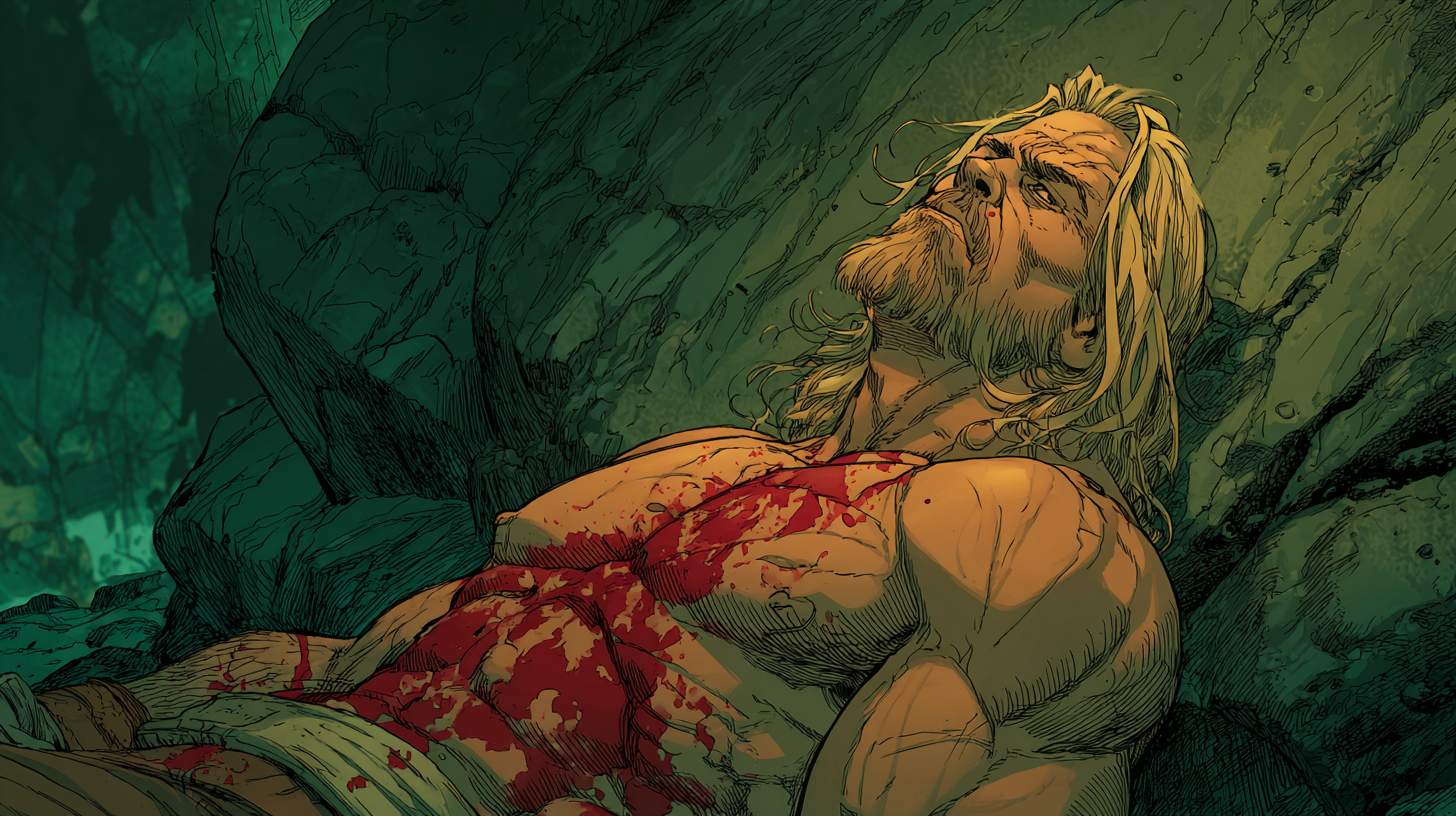
But this will only be the beginning of the casualties. Garmr will appear on the battlefield and immediately pounce on the one-handed Tyr. The clash will end in a draw, but neither warrior will survive. Thor will defeat Jormungand, but the victory will not last long. With his last breath, the serpent will spit out poison that will kill the god of thunder. Thor will take exactly 9 steps before falling to the ground and ending his saga.
In close combat, Odin will grasp Fenrir’s lower and upper jaws, only to feel, for the first time, too weak to complete the task. The raging wolf will let out a victory roar that will once again shake Yggdrasil, and then swallow the All-Seeing One. Grief will tear Frigg’s heart apart, and she will weep for the second time. Odin’s devoted son, Vidar, will witness everything and immediately avenge his father’s death. The “Silent God of the Forest” will place on the wolf’s jaw a boot made from scraps of leather that people discard when resoling their shoes. Then Vidar will deliver the final blow that will tear the beast apart.
Loki will fight Heimdall, but neither will win. Both will fall at the hands of their enemy. In his final moments, however, the guardian of Bifrost will mock the traitor. Heimdall, capable of seeing into the future, will tell Loki what awaits the nine worlds. The god of trickery will die, fully aware of his defeat. Only a few Einherjar will remain on the battlefield. Finally, Surt will unleash a force of nature that will consume the worlds, fulfilling the prophecy. Fire will devour everything in its path, thus bringing the cycle of life to a close.

Life after the end of the world
The prophecy of Ragnarok, however, has a hopeful ending. It turns out that the souls of the fallen Aesir gather in a bright palace called Gimli (heaven). There, they will recount their past adventures and the great battles they fought.
When the dust of battle settles, the lands will once again emerge from the seas and oceans, and birds of prey will begin to circle above them. It is there that those who survived Ragnarok will be found: Hoenir, Vidar, Vali, the sons of Thor—Magni and Modi, and Njord. They will be the first to meet Baldur, who manages to leave Hel’s realm.
The Aesir will also learn that even Sutra’s fire was unable to completely destroy the Tree of Life. Hidden within its crown are two people named Lif and Lifthrasir (Life and Blooming with Life). Their children will repopulate Midgard.
Where Odin’s hall once stood, Idavoll will rise, serving as the new Asgard. Thor’s sons will become the defenders of the gods, but it will take the strength of both to lift Mjolnir. The Aesir will find golden chess pieces in the tall grass, the ones used by the All-Father. The pieces will represent all the participants of Ragnarok—gods, traitors, giants, and beasts alike. Baldur will also find his likeness, set the pieces on the chessboard, and make the first move. The game will begin anew.




Comments (0)