In Norse mythology, there is no story more tragic than the fate of Baldur. It is a tale of betrayal and cruel punishment. Of fratricide. Of a love stronger than death. And of a destiny that not even the gods can escape…
This text was written by Iwona Strychalska. If this text has helped you deepen your knowledge or inspired you to create, follow Iwona’s profile by clicking here!
Baldur – The Light That Darkness Could Not Endure
Baldur (also known as Balder or Baldr) was the son of Odin and Frigg, the god of light, beauty, and innocence, and the embodiment of everything bright, pure, and just. He dwelt in the hall of Breidablik (which in Old Norse means “Far-Shining” or “Broad-Gleaming”) alongside his wife, Nanna.
In Asgard, there was no figure more cherished than Baldur. Whenever he entered a feast hall, shadows gave way to the radiance that flowed from his very presence—he brightened even the darkest of nights. He was not a warrior who sought glory in slaughter or conquest. He was a judge and an advisor, and his verdicts were always final and fair, for he possessed the extraordinary ability to see the truth. His words were like a balm to wounded souls.
He was a god beloved by the entire world. It was believed that as long as Baldur lived, the world was safe. He was the guarantor of order, a sun that was never meant to set. But his light cast shadows so deep that in one of them, Loki hid…
Prophetic Dreams and Frigg’s Journey
The peace of Asgard crumbled when Baldur began to be haunted by unsettling dreams. In them, the god saw his own death—not in glory on the battlefield, but simply fading quietly into a darkness that even he, the god of light, could not dispel…
These visions became so terrifying that Baldur sank deeper and deeper into sorrow. The Aesir, seeing their companion’s suffering, called a council to decide how to help him. It was then that Frigg, who felt her son’s fear most keenly, decided to embark on a journey through the nine worlds. She could not allow destiny to fulfill itself.
Frigg pleaded with every stone, every stream, every metal, and every living creature for a promise that none of them would harm Baldur. It seemed as though the entire world had sworn this sacred oath.
The gods of Asgard breathed a sigh of relief. A strange, unnatural certainty took hold. The Aesir, usually solemn and careful of their safety, fell into a kind of frenzied euphoria. They began to play games—throwing stones at Baldur, pricking him with spears, and hacking at him with swords, testing the invulnerability he had gained through his mother. They laughed as blades slid off his skin like water off a duck’s feathers, while Baldur stood smiling, ever beautiful and unshaken. In the eyes of the others, he had become a god whom destiny could no longer touch.
The Mistletoe That Did Not Swear
But in this world ruled by gods, one rule prevailed: nothing is fully safe if the smallest detail is overlooked…
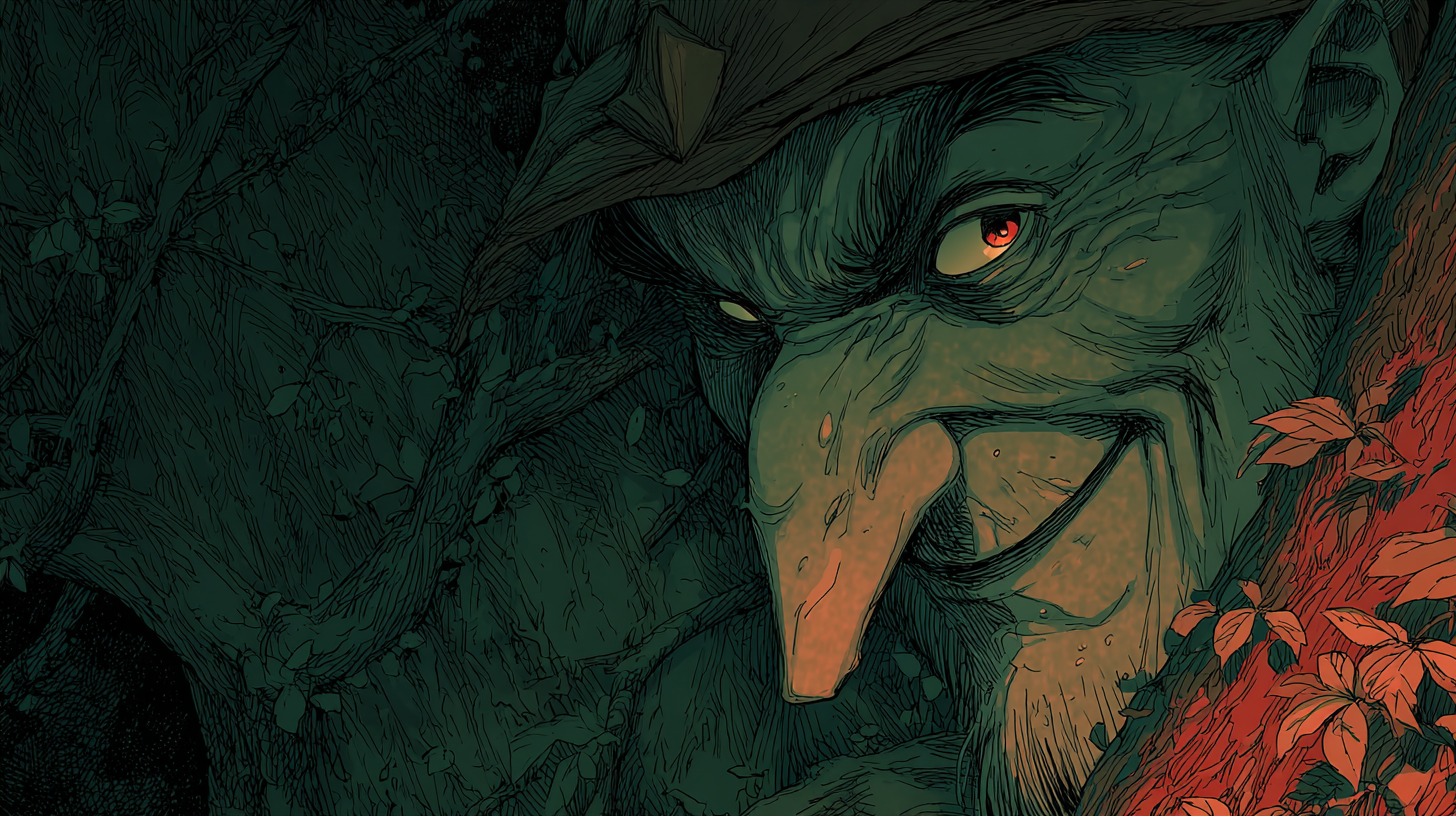
Loki, the master of lies, watched everything from the sidelines. His eyes tracked every move, every smile, every drop of sweat on the faces of the playing gods. He hated this joy. He hated the fact that everyone in Asgard now felt safe. He could not stand that everyone loved Baldur. His jealousy was like a poison slowly burning him from the inside. He had to find a crack through which he could let the darkness into Asgard. He wanted to kill Baldur—to kill the ideal, to prove that everything perfect is fragile.
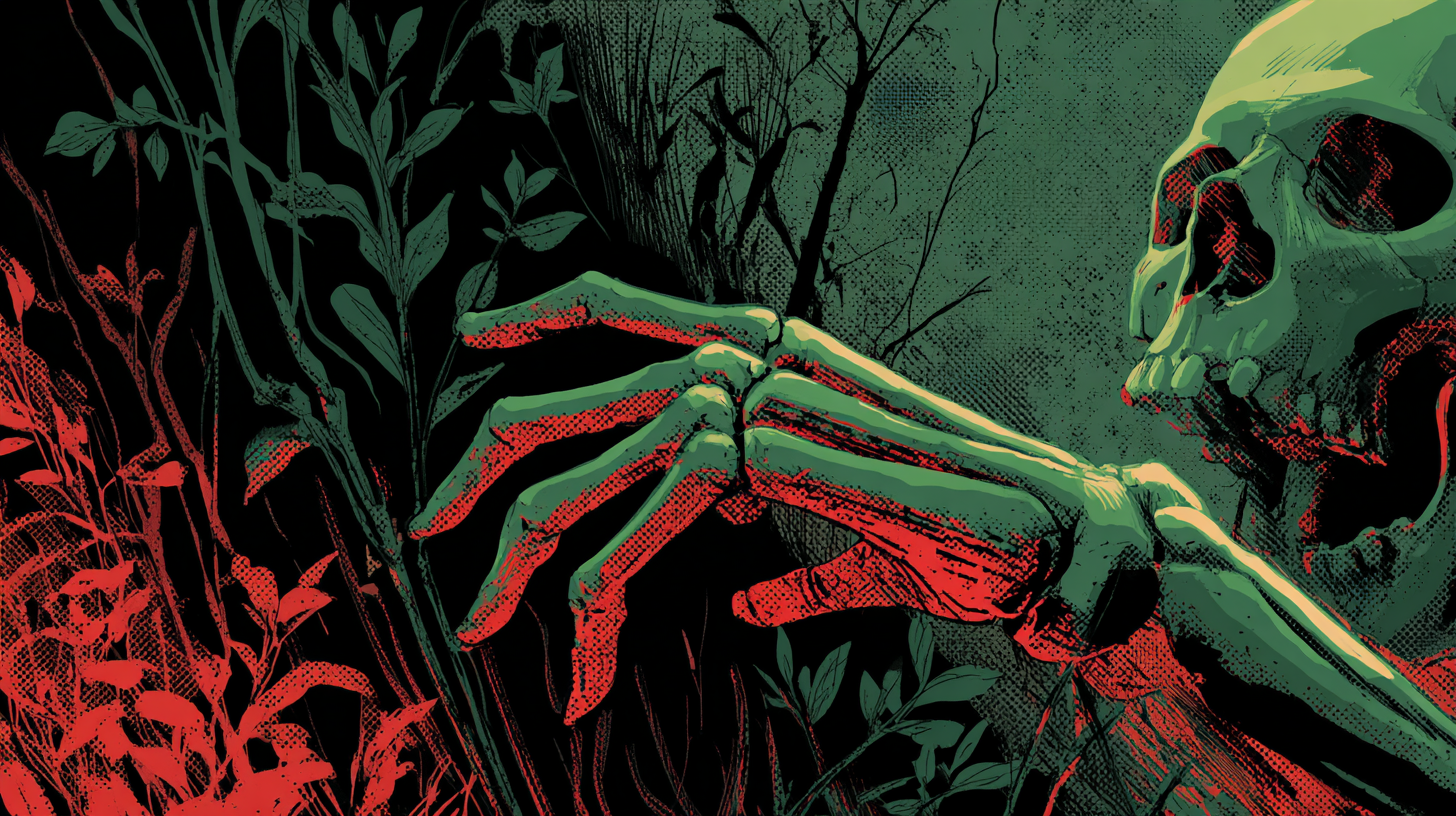
He wandered the world, eavesdropping on the whispers of all creatures, until finally, he found it… Mistletoe grew on the western side of Valhalla. In Frigg’s eyes, it was too young and weak to harm anyone, let alone kill Baldur—so the goddess had not asked it for an oath. Loki, however, saw in the mistletoe the only weapon that could shatter the order of Asgard. The trickster god’s mission was a success…
Loki stood on the outskirts of Thingvellir, the sacred field of the gods’ assembly in Asgard. He watched as the Aesir continued to hurl dangerous objects at Baldur, causing not the slightest harm to his health. The trickster’s gaze fell upon Höd. Baldur’s blind brother stood alone in the shadows, far from the clamor. Excluded by his disability, he could not enjoy the games with the others. In him, Loki saw his tool. He approached Höd as quietly as a shadow. In his hand lay a sprig of mistletoe—tiny, pale, almost insignificant.

— Why dost thou not shoot at Baldur? — Loki asked, his voice like sweet poison.
— Because I see not where Baldur is — Höd replied quietly — and also because I am weaponless.
Loki smiled to himself. He placed the sprig into the hands of the blind god and aimed his hand toward where the god of light stood.
— Shoot at him with this wand — he whispered. — I will direct thee where he stands; do thou honor him after the manner of the other men.
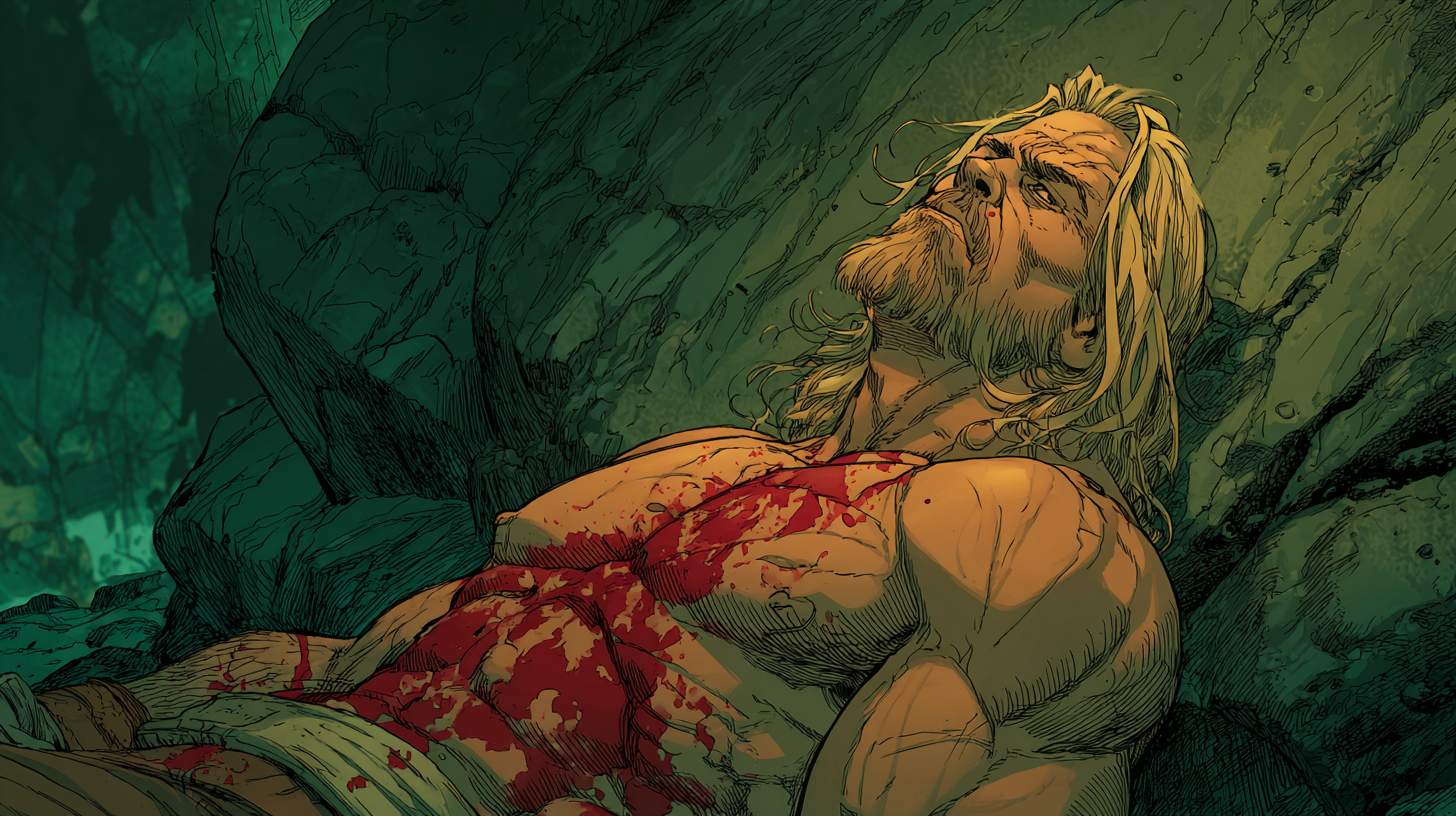
Höd, trusting in his brotherly intentions, threw the mistletoe. For a brief moment, silence fell over the field… The mistletoe did not bounce off Baldur’s skin. It pierced him like a sharp knife… The brightest of the gods faltered, looked at his brother in disbelief, and fell lifeless to the ground.
No one screamed. The gods stood like statues carved from stone, unable to comprehend that what was meant to be immortal had ceased to exist because of one fragile sprig of mistletoe. It was the moment their world collapsed… The joy of Asgard evaporated in a single second, replaced by a darkness that no light would ever truly dispel again.
The Funeral of Baldur and Nanna
The funeral was a ceremony the likes of which none of the nine worlds had ever seen. On the shore of the sea lay Hringhorni, the greatest of the gods’ ships. It was to become the funeral pyre that would carry Baldur on his final journey—to the land from which no one has yet returned.
Nanna approached the ship as one of the last, to look upon her husband one final time. There were no screams or tears—her despair was too great. And then something terrible happened. In that moment, as her eyes rested on Baldur’s pale, cold face, her heart simply broke from grief. Nanna fell dead at the feet of Hringhorni’s massive hull. In silence, the gods carried her lifeless body onto the deck and laid her beside her beloved.
Odin, in a gesture of final farewell, took off Draupnir (“The Dripper”)—his magic ring, from which eight other precious rings dripped every ninth night. He placed it on his son’s chest—a gift of eternity for someone who had run out of time… Unheard by anyone, he then whispered something into the ear of the deceased that remains the greatest mystery of Norse mythology to this day.
Baldur’s horse was also led to the pyre, so the faithful animal might accompany him in the depths of Helheim.
Hringhorni was so massive that none of the gods, not even Thor, could push it from the sands into deep water. They then summoned Hyrrokkin, a giantess from Jötunheim. It was a humiliation for the Aesir—they had to ask an enemy for help. Hyrrokkin arrived riding a massive wolf and using venomous snakes as reins. With a single shove, she moved the ship with such force that the earth around them trembled.
Thor stood before the funeral pyre to hallow it with lightning. He raised his hammer, Mjöllnir, from which sparks flew, igniting the wood. At one point, a dwarf named Litr ran beneath the feet of the thunder god. In a fit of mindless rage and despair, Thor kicked him straight into the fire. It was the gesture of a god who had lost everything he loved and, in his helplessness, destroyed the last shred of innocence remaining in that sorrowful land.
As the ship pulled away from the shore, it burst into a fire that lit up the livid sky. It became clear that this was not just the funeral of a god. It was the twilight of the era of light.
The Tear That Was Missing
Hermod, son of Odin, made a desperate attempt to mend what Loki had broken. Astride the eight-legged horse Sleipnir (Loki’s son, do you see the irony?), which his father had lent him, he rode for nine days and nine nights. Finally, he reached the depths of dark Helheim, the realm ruled by the daughter of the trickster god—Hel. When he stood before her throne, he also saw, seated in a place of honor within the palace, Baldur and Nanna locked in an embrace—even the land of the dead was a place where no one could tear them apart.
Hel, looking at Hermod with cold, motionless eyes, issued a challenge to the gods:
— If all things in the world, alive and dead, weep for him, then he shall go back to the Aesir, but he shall remain with Hel if any object speaks against him or refuses to weep.
The goddess allowed Hermod to take back proof that he had indeed reached his destination and spoken with the dead. Baldur gave his brother the ring Draupnir (asking him to take it back to Odin), while Nanna gave a linen robe for Frigg and a gold ring for her handmaid, Fulla.
The gods, hearing from Hermod that Baldur might return, sent their messengers to every corner of the world to ask for a tear. The mountains wept, crumbling under the weight of their own sorrow. The plants wept, their sap bleeding like blood. The metals deep within the earth wept. It seemed as though Helheim would open its gates.
On the way back, the messengers came upon a cave where the giantess Thökk hid in the gloom. When they asked her for a tear, she looked at them with disdain.
— Thökk will weep dry tears over Baldur’s funeral; neither alive nor dead, the old man’s son was of no use to me. Let Hel keep what she has.
In that single sentence lay all of Loki’s hatred. For Thökk was not truly a giantess. It was none other than the god of lies himself, in a perfect disguise, realizing his cruel plan. He refused to weep, for in his mind, the world did not deserve the return of light.
Baldur and Nanna remained imprisoned in the darkness of the underworld. The gods realized that even they could not win against fate, and Ragnarök (the end of everything) was no longer just a vision. It was an inevitability.
The Significance of Baldur’s Death for the Nine Worlds
Baldur personified the noblest qualities in the world of the gods: purity, justice, and light. His death was a signal that chaos had taken hold in Asgard and could no longer be stopped. If even the most perfect being could perish through trickery, it meant the old order of the nine worlds had ceased to exist. Baldur’s death was the “first crack” in the construction of the universe.
According to the myths, Ragnarök is preceded by Fimbulwinter—three years of a terrible, unending winter during which the sun loses its power. The death of Baldur (the god of light) is symbolically linked to this cooling of the world. When Baldur was gone, the inner warmth of Asgard was extinguished, leading inevitably to the freezing of the world and the final battle.
What were the further fates of Loki? Did he pay the price for his crimes? Or did he manage to escape trouble once again? What happened to Höd, who unwittingly killed his brother? What terrible secret did Odin hide? Why does a salmon have a taper near its tail?
If you are curious about the answers to these questions, I have good news—soon a new article will appear on the blog, through which you will learn the continuation of this tragic story.



Comments (0)